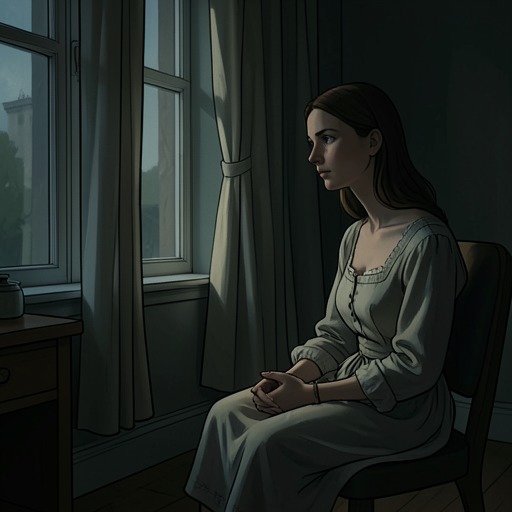
Martirio Steals Angustias’s Portrait
The House of Bernarda AlbaMartirio Steals Angustias’s Portrait is the discovery that Martirio has taken Angustias’s picture of Pepe el Romano, an episode that makes private rivalry visible inside Bernarda Alba’s tightly controlled household. The portrait’s disappearance prompts a search, but its recovery from Martirio’s bed does more than settle where the object went: it exposes a concealed attachment and gives Adela grounds to challenge her sister’s denial. The scene converts a small domestic mystery into an early, concrete sign of the conflict gathering around Pepe.
The Missing Picture
Angustias enters in a fury and asks which of her sisters has taken the picture of Pepe that had been beneath her pillow. Martirio answers that none of them has it. The exchange puts the object at the center of a household where Angustias’s engagement to Pepe already troubles her sisters, and where his portrait is a private possession that makes their rival feelings tangible.
When Martirio suggests that the picture might have slipped into the stable-yard at midnight, where Pepe likes to walk in the moonlight, her explanation is pointed rather than reassuring. Angustias tells her not to play tricks and says she will tell Pepe when he comes. Poncia intervenes, urging her not to do so and looking toward Adela as she promises the picture will turn up. That glance hints that the search is connected to the sisters’ feelings about Pepe, before the object’s location is confirmed.
Discovery in Martirio’s Bed
Bernarda orders the household searched. Poncia returns with the portrait and, when Bernarda asks where she found it, says it was among the sheets on Martirio’s bed. Martirio admits that this is true. The specific hiding place turns an accusation into a discovery: the picture was not misplaced in the yard but kept in Martirio’s own bed, making the theft part of the intimate life of the household.
Bernarda asks Martirio why she took the portrait. The question follows the discovery, but the scene does not supply a full confession or a detailed motive from Martirio. Instead, her explanation comes afterward, when she asks whether she cannot even play a joke on her sister and asks what other reason she would have wanted the picture. The gap between the hidden object and the joking explanation leaves the claim open to challenge.
Denial and Exposure
Adela immediately rejects Martirio’s account. She says that it was not a joke and that Martirio has never liked jokes; something else, she insists, had been building inside her and wanted to break out. Martirio tells Adela to be quiet and warns that if she speaks, the walls will close in from shame. Their exchange makes the theft a public breach of the family’s silence: what was concealed among Martirio’s bedding becomes a dispute over the desire and jealousy the household would rather keep unspoken.
The episode also belongs to the play’s wider pattern of family secrecy and concern with reputation. Bernarda insists that the daughters should not be heard arguing because the neighbors may listen through the walls. In that setting, the recovery of the picture threatens more than the sisters’ relations with one another: it risks making private rivalry audible to the community whose judgment Bernarda fears. The image of walls closing in on Martirio’s words echoes that pressure without resolving what, precisely, she would reveal.
Family Stakes and Dramatic Consequences
The sisters’ hostility has a material context as well as an emotional one. Angustias is the only rich daughter in the house, and Amelia observes that Pepe is pursuing her as the family’s inheritance is divided. Magdalena argues that he might more naturally have courted Amelia or Adela, and contrasts their youth with Angustias’s age and appearance. The portrait episode therefore unfolds amid resentments over wealth and marriage, not as an isolated quarrel over a keepsake.
Angustias is Bernarda’s daughter from her first marriage, and her stepfather, Antonio María Benavides, left her substantially more money in his will than he left the four daughters who were his natural children. The play’s commentary raises the possibility of an undisclosed reason for that unequal inheritance but presents it as a question, not an established explanation. The sisters’ competition around Angustias’s engagement thus sits within a household where kinship, property, and concealed relations all remain charged and uncertain.
The picture’s recovery does not end the conflict. Later that night, Martirio asks why Angustias’s fiancé has not come, and Bernarda says he has gone on a journey; Martirio looks at Adela and reacts with a brief, knowing acknowledgment. The theft scene has already established the pattern behind such exchanges: Pepe’s absence and presence are watched for, and the sisters read one another’s remarks for what they conceal. Martirio’s attempt to dismiss her act as a joke cannot contain the rivalry it has revealed.
Significance in the Plot
As a dramatic episode, the theft is a compact discovery scene: an object disappears, a suspect denies involvement, a search uncovers it, and the recovery forces hidden tensions into speech. Its force depends on the contrast between the portrait’s small physical scale and the reach of the conflict it discloses. Martirio’s concealment draws Bernarda’s authority into the sisters’ private dispute, while Adela’s accusation turns suspicion into open recognition that the theft meant something more than a prank.
The play’s treatment of family honor gives the episode a wider social resonance. Bernarda is preoccupied with preventing gossip and protecting the family name, and later she conceals the truth about Adela’s death by insisting that her daughter died a virgin. Those later actions do not prove that the portrait theft itself becomes public, but they show how aggressively Bernarda manages what others may know. In the earlier scene, the picture brings desire close to disclosure; Martirio’s warning about shame registers the cost the family’s code attaches to speaking openly.
The episode does not resolve Martirio’s feelings or the sisters’ rivalry. Instead, it establishes their continuing structure: Angustias’s engagement makes Pepe the focus of attention, Martirio hides her interest, and Adela recognizes that the explanation offered is false. The portrait’s return to the household leaves the conflict in place, but the secret it has exposed cannot be put back among the sheets.